Monday, July 8, 2013

Carnival of Space, Week #309!

Welcome to the 309th Carnival of Space! This is my fifth time hosting the Carnival; you can find my first Carnival here, my second carnival here, my third carnival here, and my fourth carnival here

The Carnival is a weekly round-up of space stories from around the internet. If you've got a space-related blog, you too can join the Carnival of Space. Email carnivalofspace at gmail dot com to host, share a story you wrote, and to get to know other space bloggers!


Source: darkroastedblend.com.

Urban Astronomer shares news of Scopex 2013, a telescope and astronomy expo starting July 20th in Johannesburg, South Africa. 

Next Big Future features a recently released study demonstrating that the number of potentially habitable planets orbiting red dwarfs may be double what we previously believedAlso over at Next Big Future there's news from the United Kingdom: funding proposals are moving forward for a super-fast, prototype rocket plane, the Skylon.

Chandra X-Ray Observatory has posted some dazzling photos of supernovas, along with a few interesting facts that scientists have learned about these explosions.


Source: darkroastedblend.com.

We've found some odd new rocks on Mars... the Meridiani Journal shares photos and speculation on these "weird bubble" formations.

Astroblog features some beautiful photos of the Aurora Australis taken last month in Australia and Tasmania. Astroblog also shares the names of Pluto's most recently discovered moons, and features a story on the Asteroid 5099 Iainbanks!

The Venus Transit recalls the history of Israel's first satellite launch, which occurred 52 years ago last week.

Universe Today reports that there's a risk that landing a spacecraft on an asteroid could create an avalanche.

Links Through Space shares news of the European Week of Astronomy and Space Science. It's the annual meeting of the European Astronomical Society, occurring this week in Finland!


Source: Tumblr.

Thanks to all of this week's excellent posters! Stay tuned for next week's Carnival, over at the Chandra X-Ray Observatory Blog...

Monday, May 27, 2013

Do You Need to Wear a Spacesuit on the Moon?

Surprisingly, no! With a few caveats: you'll have to wear warm socks and shoes, a mask hooked up to an oxygen supply, and you better keep on the dark side of the moon (or the shadows of the light side). You won't be comfortable... but the temperature, radiation, and vacuum won't kill you immediately.

Neil Armstrong, partially suited up.
From a stain glass panel at the Naval Museum in Valparaiso, Chile.

Since the moon doesn't really have an atmosphere, there's nothing insulating its surface from wild temperature swings. It gets as cold as nearly -250 Fahrenheit in shadow or on the dark side and up to nearly 225 Fahrenheit in the sun. On Earth, either extreme would quickly be fatal to an unprotected human. And on the light side of the moon, heat radiating from the sun would be dangerous. But the dark side of the moon is a different story. In the near-vacuum of space, your body is far slower loosing heat than here on Earth, because there is no air to conduct heat away from your body. That's why -250 Fahrenheit in the near-vacuum of space would not feel horribly cold. 

However, if you touched anything at the ambient temperature of the dark side of the moon, you'd feel quite a chill, because matter will conduct heat efficiently, unlike the vacuum. So, you'd just need to wear boots with well-insulated soles, otherwise the bottoms of your feet would quickly freeze and would conduct away heat from the rest of your body too. Well-insulated gloves would also be a good idea if you plan to pick up any moon rocks!

Al Bean, Neil Armstrong, and Roger Chafee completing pre-mission geology training.
You could dress like that on the dark side of the moon! (For a while at least...)
Source: senior-crown.tumblr.com.

As long as you can breathe, the vacuum does not pose as big a risk to the rest of your body as you might think. We regularly experience changes in air pressure here on Earth, by swimming underwater or climbing a mountain or flying in a plane. Walking around in an absolute vacuum would draw fluid to your skin, breaking some small blood vessels at the surface and bloating you. But in the short term, you wouldn't inflate like a balloon or explode or anything gross, you'd just look puffy and feel uncomfortable.

Preferably, your breathing apparatus would cover your eyes, nose, and mouth. Otherwise the moisture in your eyes, nose, and mouth would evaporate quickly into the vacuum. And, your exposed skin would dry out uncomfortably. Eventually, radiation would become a concern, too.

During a record-breaking high-altitude jump, Colonel Joe Kittinger 's right suit glove depressurized in near-vacuum.
His hand didn't explode, but it did swell up painfully.
Source: Wikipedia.

So for all those reasons, and because anyone in sunlight would overheat without insulation, astronauts on the moon or on spacewalks wear spacesuits. These bulky, heavy, mobility-limiting pressurized suits (including life support systems, the typically extravehicular activity suit weighs over 300 pounds!) insulate astronauts as they move between shadows and sun. They also provide some radiation protection, and they prevent skin from swelling up uncomfortably.

An alternative to the type of spacesuit astronauts use today is a "hard" spacesuit:
The whole suit is pressurized, but since it is hard, rather than soft, it does not puff up and make joint mobility difficult, and can also be more pressurized than a "soft" suit.
Source:  mlkshk.com.

But there is an alternative to the traditional, fully pressurized spacesuit we're used to. Astronauts could wear a mostly unpressurized spacesuit. The entire suit body could be unpressurized, except for the helmet and maybe the gloves and boots. The main function of an unpressurized spacesuit is to provide insulation, radiation protection, and prevent vacuum-induced swelling. It does these things not by creating an atmosphere inside the suit, but by mechanically compressing the whole body. This is why the unpressurized suit's gloves and boots are still pressurized- all the small joints in the hands and feet make it hard to compress their surfaces evenly and thoroughly.

Back in the 1960s, NASA first worked on creating an unpressurized suit, but that program was discontinued around when the Apollo missions ended. Here's a prototype of the unpressurized suit engineers were designing:

A prototypical unpressurized spacesuit, which compresses the body mechanically.
Source: NASA.

NASA revisited the notion of the unpressurized suit recently, funding the Massachusetts Institute of Technology's development of the "bio-suit." MIT Professor Dava Newman, the lead scientist on the project, models the suit her team designed:

Professor Dava Newman models the bio-suit.
Source: NASA.
Needing to design a suit that would compress the body rather than be airtight, Prof. Newman drew on the experience of an Italian manufacturing company that produces carbon-fiber racing suits for European race car drivers. Unlike the unpressurized suit designed during the Apollo program, the bio-suit's material has elasticity. It stretches with the wearer, and it doesn't overly-compress a person wearing the suit in a pressurized atmosphere.  The old-fashioned Apollo era unpressurized suit had no elasticity. Thus it would squeeze the wearer so tightly that if he or she wasn't in a vacuum, the circulation of blood would be constricted and he or she would pass out in less than a half hour!

While the bio-suit has to be modeled specifically to fit each individual wearer's body, its materials and construction are so much simpler than pressurized spacesuits that it could still be dramatically cheaper to produce. And, as you can see from the above photo, the bio-suit allows normal movement. Unlike the Apollo astronauts, whose suits allowed only partial movement of the knees, elbows, and torso, a bio-suit wearer has a fairly normal range of motion.

A puncture in the bio-suit won't threaten the air supply, either- you can just patch it with a bandage-like wrap. And, the bio-suit could weigh just a small fraction of the weight of a traditional, fully pressurized suit. Even without the air supply, an extravehicular activity suit still weighs over 100 pounds- which isn't a problem in micro-gravity, but would be a serious encumbrance to walking around on a planet like Mars.

The suit looks really futuristic, doesn't it? Not that how it looks matters, of course!
Source: NASA.

I think the bio-suit is so neat! But like so many amazing ideas for space exploration, Prof. Newman's project is not fully funded. Her team has not yet produced a prototype that could safely be tested by actual astronauts in outer space. All research on the suit to date shows that it is a workable, useful concept. So, I hope one day folks can test it out in Earth orbit or beyond!

Sources: NASA; Wikipedia; MIT; Slate; Spectrum.ieee.org; damninteresting.com.

Sunday, April 28, 2013

Carnival of Space, Week #299!

The Sun.
Source: Wall Street Journal.

I am hosting the Carnival of Space again this week!! This is my fourth time hosting the Carnival; you can find my first Carnival here, my second carnival here, and my third carnival hereThe Carnival is a weekly round-up of space stories from around the internet. If you've got a space-related blog, you too can join the Carnival of Space. Email carnivalofspace at gmail dot com to host, share a story you wrote, and to get to know other space bloggers!

This week's Carnival of Space explores our solar system and beyond, and includes a lot of news about spaceships! Read on for some interesting stories...

Mercury.
Source: NASA.

Urban Astronomer shares news of a recent discovery by NASA's Chandra X-ray telescope: a huge halo of super-hot gas that surrounds our galaxy!

Folks in Europe, Africa, Asia, and Australia might have seen last week's partial lunar eclipse, which was the briefest lunar eclipse that will occur this century. Gadi Eidelheit of Venus Transit shares his photos of the partial lunar eclipse.

The Meridiani Journal shares news about Jupiter's atmosphere: it's got lots of water, thanks to the impacts of comets over the years!

Saturn.
Source: One Minute Astronomer.

Earth Science Picture of the Day features a beautiful photo of a chrondrite meteorite and chrondrules, as well as an explanation of their composition and origin.  

Dr. Paul Spudis of The Once and Future Moon explains what we've learned about the composition and formation of the lunar crust from the Apollo and GRAIL missions.

Everyday Spacer shares some space-related activities you can do locally or online. Reading Everyday Spacer is a great way to find out about many different space exploration themed events that you can do- often, right in your hometown!

Cheap Astronomy's fascinating recent podcast tells the story of seven lesser-known astronauts: the "increment astronauts."

Over at Astroblog, Ian Musgrave shares some neat amateur space photos: the Comet C/2012 F6 Lemmon; the occultation of the star Alpha Librae (also called Zubenelgenubi, which means "southern claw" in Arabic); and photos of last week's partial lunar eclipse as well. 

Jupiter.
Source: elf_leon.livejournal.com.

The Next Big Future shares recent some exciting recent developments in spaceflight. It features news from the Harvard Business Review, which examined SpaceX's process for cost innovation in spacecraft development, and how SpaceX can serve as a model for other businesses. In more SpaceX news, the Grasshopper recently flew 820 feet straight up in a test flight, and Next Big Future features a video of the flight. Virgin Galactic's SpaceShipTwo is going to embark on a hypersonic test flight sometime in the next few days... and then hopefully it'll be headed into space later this year! The Next Big Future also shares news about the Starship Century Symposium, which is coming up in a couple weeks; attendees of this conference will discuss whether this will be the century we travel beyond our solar system. I wish I could be there, it looks like it's going to be so, so cool!

Lastly, on my blog, I told a story about the Apollo Guidance Computer, and a computer glitch that could have derailed Neil Armstrong and Buzz Aldrin's moon landing.


Neptune.
Source: NASA.

Wednesday, April 24, 2013

Tech Support On the Way To the Moon

In honor of Boston, this week I'm telling a little story about the Apollo Guidance Computer, which was designed and built at the Massachusetts Institute of Technology.

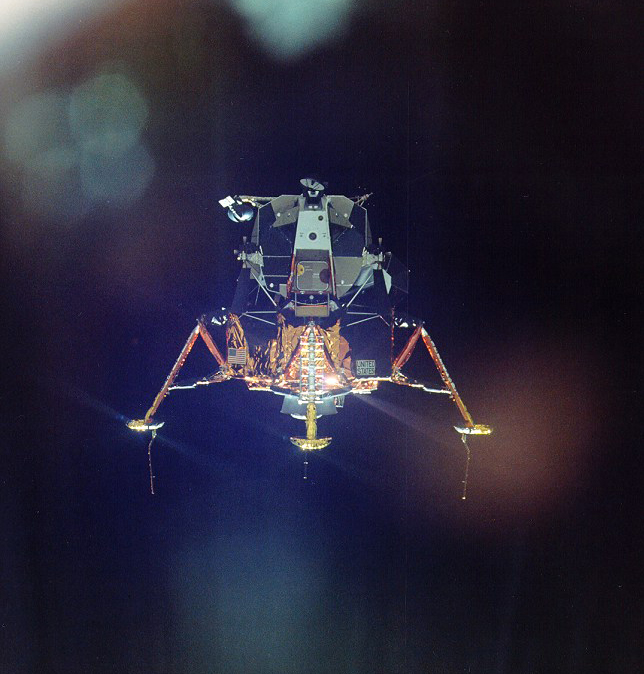
The Apollo 11 lunar module, just after undocking from the command module.
Source: National Geographic.


The Apollo Guidance Computer* gave Apollo astronauts the data they needed to pilot the command module and lunar module during lunar landing, ascent, and docking. There was so little room for error in these tasks that the precision afforded by a computer was necessary. When the Apollo Guidance Computer was built, it was a technological feat... but it is roughly comparable in terms of processing power to today's graphing calculators. Nowadays, if you have some programming expertise and a lot of spare time, you can actually build your own Apollo Guidance Computer, no MIT degree or MIT lab facilities necessary. I wish building a Saturn V rocket was that easy!

 * = Actually, there were two Apollo Guidance Computers aboard every flight to the moon. One aboard the command module, one aboard the lunar module. Plus, there was a launch computer inside the Saturn V rockets and an abort computer in the lunar module.

An engineer with a mock-up of the Apollo Guidance Computer interface.
Source: MIT.

While shockingly simple compared to today's computers, the Apollo Guidance Computer was a very capable piece of equipment. It could multi-task, performing up to eight different calculations at the same time. It could also prioritize its memory as needed. And, it was relatively small and lightweight, an important design feature on a mission that was already consuming nearly a million gallons of fuel just to leave Earth's gravity. At a time when room-size computers were common, the Apollo Guidance Computer weighed 70 pounds and occupied about one cubic foot of space.

An MIT Instrumentation Lab engineer runs tests on the Apollo Guidance Computer.
Source: MIT.
Like any modern computer, the Apollo Guidance Computer didn't always work perfectly. Any number of problems would trip it up, and it would respond by producing an error code. There were many, many possible error codes. Some error codes signaled computer malfunctions, some required immediate corrective action, and some could just be ignored. Astronauts and mission control staff devoted considerable training time to learning what each error code meant, and how they should respond.

The crew of Apollo 11, and the "moon."
Source: ontheunspeakable.tumblr.


NASA Flight Director Gene Kranz's autobiography, Failure Is Not an Option, tells an interesting story about these error codes. Astronauts and ground crew spent weeks and weeks practicing mock missions in advance of the Apollo flights. They'd run through these fake missions just like they were the real thing, with Simulation Supervisors throwing problem after problem at them. Sometimes, mission control would work out a solution in time to salvage the moon landing and save the fake flight. Sometimes they wouldn't figure out a solution in time and the simulation would end with a fake disaster.

A fisheye view inside one of the Apollo lunar module simulators.
Source: howstuffworks.com.


The Simulation Supervisors were always relentless, with one exception. They gave mission control a relatively problem-free flight for the final pre-launch simulation. That way, the practice runs would end on a high note, with mission control engineers feeling that they were completely prepared for the real flight.

So, a few days before the launch of Apollo 11, Kranz and his crew went into the final scheduled lunar landing simulation expecting an easy flight. During the practice descent, the Simulation Supervisor sent the lunar module's Apollo Guidance Computer a "1201" error code. Not a single engineer in mission control knew what this code meant. Without any idea of what had gone wrong, the only safe choice was to abort the landing.

Richard Koos, the Simulation Supervisor, gave mission control the bad news: calling off the landing was the wrong decision. The 1201 code just meant that the Apollo Guidance Computer was temporarily overloaded; it did not indicate an impending computer crash or any other mission-critical problem. Kranz and mission control had just (in pretend) wasted the Apollo 11 flight and ruined their chance at a moon landing because they hadn't known what the 1201 code was.

Crowds in Grant Park, Chicago watch the first moon walk.
Source: Washington Post.


Recounting the story in his autobiography, Kranz tells how furious and ashamed he was. Kranz, along with Jack Garman (the engineer charged with keeping track of Apollo Guidance Computer codes), Chris Bales (a guidance officer) all had that particular series of alarm codes seared into their brains. They would never forget what a 1201 (or a related code, 1202) meant.

Astronauts Charlie Duke, Jim Lovell, and Fred Haise in mission control during Apollo 11.
Source: Wikipedia.

A few days and a few hundred thousand miles later... the real Apollo 11 lunar module was descending to the moon with less than 10,000 feet to go when the Apollo Guidance Computer produced a 1202 alarm code, and then a 1201 alarm code. Neil Armstrong and Buzz Aldrin asked mission control what the alarms meant. Thanks to the final simulation, Kranz, Bales, and Garman knew the answer right away- they were "go" on the alarm! Capcom Charlie Duke told them they could ignore the alarms and keep descending. Just a couple minutes later the Eagle landed safely in the Sea of Tranquility!

Celebrating after the Eagle landed.
Source: wallcoo.net.

What caused the 1201 and 1202 alarms? The Apollo Guidance Computer was receiving too much radar data. Buzz Aldrin (an MIT grad!) had asked MIT engineers to design the computer to be able to track both radar readings from the lunar surface and the command module. This would allow a quick decision to land or return to the module. But the Apollo Guidance Computer couldn't properly track both sets of data. So at the stage in lunar descent when the alarms occurred, the computer was getting simultaneous readings from both radar systems, and it was causing brief system overloads. 

Sources: American Space; Popular Mechanics; NASA; doneyles.com; Gene Kranz, Failure Is Not an Option; Air & Space's The Daily Planet blog; Computer Weekly; Wikipedia.

Saturday, April 6, 2013

What Laws Apply In Low Earth Orbit? (Besides Newton's Laws!)

A couple weeks ago I was revising a manuscript on comparative intellectual property law, and I came across  a little quirk in the United States' patent law. 35 U.S.Code Sec. 105 gives the United States patent law jurisdiction over inventions made in outer space, so long as one condition is met. The invention must have occurred on a space ship that is "under the jurisdiction or control of the United States."

Under 35 U.S. Code Sec. 105 Romulan cloaking technology is not subject to U.S. patent law.
Source: Memory Alpha.

U.S. law says a bit more on the subject, but the bottom line is that if you invent a patent-able product and you're aboard a U.S. space ship, U.S. law applies to your patent claim. American courts can therefore hear interplanetary patent cases! (Though there haven't actually been any such courts cases just yet.)

Finding this interesting fact got me wondering how Earth laws apply to the International Space Station. The station is a completely international endeavor, as it is constructed of modules built by the Russians, the European Space Agency, the United States, and the Japanese. The current crew consists of a Canadian, two Americans, and three Russians. What if one of them commits a crime affecting another nationality- what country's law applies?

Judging humanity since 2364.
Source: ragnerdrok.com. 

In 1998, the fifteen countries that built the ISS signed a treaty, the ISS Intergovernmental Agreement, that explains (among other things) who has criminal jurisdiction aboard the Station. This treaty is just one of a number of international agreements between various countries that establish cooperation in the construction and use of the ISS.

Article 22 of the ISS Intergovernmental Agreement sets forth what happens if a crime were to occur on the Station. If the crime affects just one country (for example, a U.S. astronaut damaging an American-built space station module) then the affected country prosecutes its own astronaut-citizen for the crime. But what if more than one country's astronaut or property is involved?

Who has jurisdiction?
Source: Wikipedia.

Here's a little hypothetical showing how jurisdiction would work for a crime committed aboard the ISS involving multiple nationalities. (As is probably obvious, I recently discovered Star Trek, the original series, on Netflix.)

A Canadian astronaut (I'll call him "Captain Kirk") and a Russian cosmonaut (I'll call him "Ensign Chekov") get into a heated argument in the American-built Destiny module aboard the ISS. The subject of the argument is Ensign Chekov's latest scientific experiment: he's breeding tribbles inside the Destiny Module. There are too many of them, they smell bad, their fur is clogging the station's air filters, etc. Captain Kirk wants to send all the tribbles to Earth on the next Dragon X flight; Chekov objects. The argument escalates. There's some yelling, some pushing and shoving, things get more heated, and before you know it, Captain Kirk has fired a phaser,* wounding Chekov and causing several million dollars worth of damage to the Destiny Module.**

* = No one has actually invented a phaser yet... but if Captain Kirk invented it in an American-built ISS module, he'd be subject to U.S. patent law!

** = Lucky for Kirk, the Ensign didn't have "Chekov's pistol." :-D

The trouble with tribbles.
Source: www.guineapigtoday.com.

What happens next? Under Article 22, the two victimized countries (the U.S., which suffered damage to Destiny, and Russia, whose national was wounded) are obliged to negotiate with Canada until either (1) Canada agrees with whatever the U.S. and Russia want regarding jurisdiction over the crimes or (2) Canada begins to prosecute Captain Kirk's for his alleged crimes against U.S. property and a Russian national. The three countries have a predetermined amount of time for either of these two events to happen. After that time expires, Russia can prosecute Kirk for the crime against Chekov, and the U.S. can prosecute Kirk for the damage to the Destiny Module.

Senior governmental officials at the Kennedy Space Center,  in the early days of ISS  cooperation.
Source: NASA.

The ISS Intergovernmental Agreement even provides a process for the alleged criminal's country to extradite him or her to the victim country. Presumably, extradition happens after the alleged criminal returns to Earth... the treaty doesn't contemplate imprisoning someone of one nationality in the victim country's ISS module!

But, there are plans in place for immediately handling unrest or violence aboard the station. Astronauts are subject to an ISS Code of Conduct while in orbit. And, a crew disciplinary policy applies in the event of a violation of the Code of Conduct. Under this policy, Code violations are to be addressed as necessary by the ISS commander. The commander should first issue a verbal warning, then, if necessary, a written reprimand. Finally, he or she is authorized to remove from duty anyone threatening to damage the station or endanger the crew.

Did someone mention space stations and crime?
Source: Wikipedia.

Sources: The European Space Agency; NASA; The International Space Station Intergovernmental Agreement; Stacy Ratner, Establishing the Extraterrestrial: Criminal Jurisdiction and the International Space Station, Boston College Int'l and Comp. L. Rev. (1999); Spaceref.com; Space.com.

Saturday, March 23, 2013

Around The World The Hard Way

On December 2, 1941, a Boeing 314 seaplane departed Treasure Island, California. Called the Pacific Clipper, the plane and its ten crew members were under the command of a veteran Pan Am captain, Robert Ford. They were scheduled to make a round-trip commercial passenger flight to Auckland, New Zealand. Along the way to Auckland, the plane proceeded with scheduled stops in San Pedro, California; Honolulu, Hawaii; Kanton Island, Kiribati; Suva, Fiji; and finally Noumea, New Caledonia. 

Treasure Island in 1939.
The island is man-made, created off the coast of San Francisco between 1936 and 1937.
Source: Wikipedia.

On the morning of December 7, 1941, the Pacific Clipper left New Caledonia for Auckland. A few hours into the flight, Radio Operator John Poindexter received a coded message: the Japanese had attacked Pearl Harbor. The Pacific Clipper crew (and the rest of the United States) were now effectively at war. The clipper was not armed, so the crew could only hope to avoid an encounter with Japanese forces. They turned off the radio and steered a few dozen miles off their planned route. Two crew members were stationed in the navigation cupola at the top of the fuselage to watch for Japanese aircraft. Captain Ford took out his revolver.

Tiny Kanton Island. Before the jet travel era, it was a common refueling station for commercial and military flights.
Back then, it had a population of over 1,000. Nowadays, the population is less than 50.
Source: Wikipedia.

Fortunately, no attack came, and the plane landed safely in Auckland a few hours later. But that left a larger issue to resolve: what would happen to the clipper?

The Pacific Clipper was owned and operated by Pan Am, and its crew were all civilians. But the plane was a valuable military asset. Only twelve such seaplanes existed in the whole world. Their engine design was quite advanced; and they were the only aircraft with such heavy-lift, long-distance, and high-speed capabilities belonging to the Axis or Allies. While a propeller-driven seaplane that must make refueling stops to travel between California and New Zealand may seem primitive in 2013, back in 1941 it was cutting edge. If necessary, the clipper crew would have to destroy the plane to keep it out of enemy hands. Ideally, though, they could return it safely to the U.S. so it would be able to contribute to the war effort.

On the flight deck of a Boeing 314.
Source: The Flying Boat Forum.

Upon arrival in Auckland, Captain Ford sent a message home via the local U.S. consulate, asking what to do with the clipper. But the U.S.'s imminent entry into World War Two meant that hundreds of coded messages were flooding the consulate. It took a full week for backlogged staff to decode Captain Ford's instructions: he was told to bring the plane home safely to the U.S.

A Pan Am Clipper over San Francisco.
Source: http://willigula.tumblr.com/.

This presented a problem. The Pacific Clipper could not just retrace its path back east to California. The Japanese had effectively cut off that route, as so many small islands throughout the South Pacific were now under attack or under evacuation orders. That left one alternative: Captain Ford and his crew were to head west instead of East. This would mean a 23,000 mile trip, circumnavigating a world at war.

Winston Churchill aboard a Boeing 314 during the war.
He traveled to the U.S. aboard a clipper several times during the war.
Source: Wikipedia.

Given the situation, the clipper crew would be without ground support for much of this long trip. Pam Am staff in Aukland would help them pick their route home, choosing bodies of water they could land in, but it would be up to the clipper crew to procure spare parts and fuel along the way. There would be no weather forecasts (no weather satellites, too, of course!) and no military escort. Before leaving Aukland, a local Pam Am staffer, Bill Mullahey, collected all the navigational charts, maps, and even geography textbooks that he could find, and he and Ford planned the route. The crew painted over the plane's Pam Am logo and serial number in gray camouflage.

The forward compartments in a Boeing 314 model cutaway.
At the Smithsonian National Air and Space Museum at Dulles.
Source: travelforaircraft.wordpress.com.

Before setting out for home, the clipper needed to retrace its steps a bit, to evacuate Pan Am staff and their families from New Caledonia (which never fell to Axis powers, though it did become key to the allied war effort in the South Pacific). On December 16, the Pacific Clipper flew back to Noumea. Upon landing, Captain Ford gave local Pan Am staff and their families one hour to pack. Then, with the twenty-two passengers aboard, the plane headed to Gladstone, Australia. From there, the next day the clipper crossed Australia, landing in Darwin, in the northwest of the country. The crew fueled the plane, slept for four hours, and set off again, bound for Surabaya in the Dutch East Indies (now Indonesia).

Surabaya today. The city was occupied by the Japanese between 1942 and 1945.
Source: Trekearth.com.

On approach to Surabaya, four British fighter aircraft flew out to meet the Clipper. Over the radio, Poindexter could hear the fighter pilots talking among themselves, trying to figure out what to make of this unmarked, never-before-seen plane. The clipper's radio wasn't working quite right, so Poindexter couldn't hail them. Several tense minutes passed while the British pilots debated what to do. Eventually one of them spotted the faint outline of the painted-over American flag on the plane's tail, and they decided not to attack. Instead the four fighter planes escorted the clipper till it landed in the mined waters off of Surabaya. That evening, Captain Ford encountered the pilots in the officer's mess. He recalled later that the four were very young and very trigger-happy. The Pacific Clipper's crew was lucky not to be shot down that day.

Center section of a Boeing 314.
Source: travelforaircraft.wordpress.com.

In Surabaya, the crew encountered their first mechanical challenge. Clippers were built to run on 100 octane aircraft fuel, but there wasn't any 100 octane gas available in Surabaya, so the plane had to be refueled with just automobile gasoline. According to Captain Ford, "we took off from Surabaya on the 100 octane, climbed a couple of thousand feet, and pulled back the power to cool off the engines ... then we switched to the automobile gas and held our breaths. The engines almost jumped out of their mounts, but they ran."

The aft compartments in a Boeing 314 model cutaway.
Source: travelforaircraft.wordpress.com.

The clipper made it safely to the harbor at Trincomalee, Celyon (nowadays Sri Lanka). Flying under the cloud cover so that they would not miss the island, the Pacific Clipper accidentally buzzed a Japanese submarine patrolling off shore. The submarine crew was out sunning themselves, and they scrambled to anti-aircraft gun when they saw the clipper. Ford pointed the nose up and throttled the engine, climbing out of range.

Buffet dinner aboard a pre-war clipper.
Source: The Flying Boat Forum.

The Pacific Clipper left Trincomalee on Christmas Eve, and almost immediately one of the engines started leaking oil. The crew turned the plane around and headed back to the harbor. The two flight engineers, Swede Rother and Jocko Parish, took apart the broken engine and fixed it, using tools borrowed from a British warship in the harbor. The plane set off for Karachi, India (now Pakistan) on Christmas day, flying across the subcontinent and landing safely. The crew got a few nights' rest at the Carleton Hotel in Karachi, setting off for Bahrain on December 28.

The flight deck of a Boeing 314.
Source: The Flying Boat Forum.

Upon landing safely in Bahrain, the crew again couldn't obtain 100 octane aircraft fuel, and had to refuel using automobile gasoline instead. They set off across the Arabian Peninsula, with the engines knocking and sputtering, and landed on the Nile in Khartoum, Sudan. The Pacific Clipper couldn't head north from there, since that would take the plane right into the middle of the war. They couldn't head due west, since a long trip across the water-less Sahara desert would have been too risky. Instead, the Pacific Clipper headed southwest to the Belgian Congo (now the Democratic Republic of Congo). They had some engine trouble soon after take-off, but decided to press on, since there weren't spare parts in Khartoum anyway.

A Boeing 314 operated by the British Overseas Airways Corporation.
Source: Wikipedia.

The crew navigated across Africa by matching rivers and other landmarks to features on their maps, landing on the Congo River in Leopoldville (now Kinshasa) on New Year's Day. Pan Am ground crew greeted the Pacific Clipper crew with cold beers, "one of the high points of the whole trip," according to Captain Ford!

The catwalk inside of Boeing 314 wing.
Source: The Flying Boat Forum.

The next leg of the journey, across the Atlantic, was by far the longest, so the Pacific Clipper was filled to the brim with fuel when it took off from the Congo River. The heavier-than-usual, fuel-laden aircraft lifted out of the water slowly, just before it would have plummeted over a waterfall at the end of the "runway." Captain Ford steered the craft along the African coast for a little while, monitoring the engines to make sure everything was running smoothly. Satisfied that it was running fine, he steered the clipper out over the Atlantic. 3,583 miles and just under 24 hours later the plane landed in the harbor at Natal, Brazil. There, they refueled and were robbed, loosing their maps and all the various currencies they'd collected from the stops along the way. The clipper spent just four hours in Natal before departing for Port of Spain, Trinidad.

A stewardess in the galley of a pre-war Boeing 314.
Source: The Flying Boat Forum.

Trinidad to New York was the last leg of the trip. On the morning of January 6, 1942, air traffic control at La Guardia in Long Island, New York received a radio message: "Pacific Clipper, inbound from Auckland, New Zealand, Captain Ford reporting. Due to arrive Pan American Marine Terminal LaGuardia seven minutes." The Pacific Clipper had made it home, flying 31,5000 miles since it left Treasure Island!

The entire 31,500 mile long route.
Source: http://geoscience.wisc.edu/~maher/pacclip.html.

What became of the Pacific Clipper and the other Boeing 314s after 1941? During World War 2, the planes often flew military missions, while crewed by civilian Pan Am employees. A clipper flew President Roosevelt to the 1943 Casablanca Conference; they made military flights from the U.S. to locations as distant as Russia and Liberia. Nine of the twelve planes survived the war intact. By the time the war ended, the clippers were no longer cutting-edge craft they were in 1941. Lockheed Constellations and Douglas DC-4s rendered seaplanes obsolete.

A DC-4. Looks pretty much like any modern airplane, doesn't it?
Source: Wikipedia.

The U.S. Navy bought the Pacific Clipper from Pan Am in 1946; then sold it to Universal Airlines. Soon after that, it was damaged in a storm and sold for parts. In fact, all of the remaining clippers were sold for scrap by 1951, and none exist today. Aircraft technology was evolving so quickly at that point that the Boeing 314s had become out-of-fashion relics, apparently not thought to be worth preserving in a museum.

Sources: Pacific Clipper's Round-the-World Flight; Wikipedia; Patterico; Smithsonian AirSpace Blog; Flying Clippers.

Sunday, March 10, 2013

Carnival of Space, Week 292!

Welcome to the Carnival of Space! This is my third time hosting the Carnival; you can find my first Carnival here and my second carnival hereThe Carnival is a weekly round-up of space stories from around the internet. If you've got a space-related blog, you too can join the Carnival of Space. Email carnivalofspace at gmail dot com to host, share a story you wrote, and to get to know other space bloggers. 


Cassini's view of Saturn.
Source: NASA.

This week's carnival of space is rather dramatic! Read on to learn strategies for galactic domination... to see storms on Saturn and the Sun... to learn about threats facing the Earth (sequestration) Mars (a possible collision with a comet?) and Europa (sharks?! Well, maybe...) 

We are all in the Gutter explains how video game data can help use decide which galactic domination strategy is best.

The Chandra X-Ray Observatory blog shares recent discoveries in probing extreme matter through observations of neutron stars.

There's big news this week from one of Jupiter's moons! The Meridiani Journal and Yahoo News reports that Europa's oceans appear to be somewhat similar to Earth's ... the chemical composition may be able to support marine life.


Cracks on Europa (possibly reaching down to a subsurface ocean?)
Source: Space.com.

In an interview this past week, NBC News anchor Brian Williams expressed disappointment in the U.S.'s limited commitment to manned space flight. The Examiner reports that Williams wants to see a U.S. role in exploration beyond the International Space Station and unmanned missions.

The Earth isn't the only planet in our solar system threatened with extraterrestrial collisions these days! The Examiner reports that a comet may his Mars next October.


Mist rising from gullies on Mars.
Source: Riding with Robots on the High Frontier.

What effect will sequestration have on NASA? Yahoo News examines a House bill to ensure funding to NASA's commercial space program and Space Launch System.

Does news of the sequester make you want to leave our planet? Universe Today shares Golden Spike's announcement seeking crowdfunding for its planned commercial missions to the moon.

One of the charms of a trip to the International Space Station is the beautiful view. Astronotes shares ten amazing photos taken by the astronauts and cosmonauts aboard the ISS.

A beautiful long-exposure photo from the ISS.
Source: NASA.

SpaceX is developing a new spaceship that will be reusable  and can land anywhere on Earth, similar to a helicopter  Next Big Future reports that this craft, the Grasshopper, successfully completed a short test flight this past week.

Andrew Fraknoi: Exploring the Universe shares a video recorded by a Sun-observing spacecraft, showing a massive solar eruption and a resulting rain of hot particles

Recently the Cassini space craft has been watching a huge storm on SaturnWeird Warp reports on this storm, and shares beautiful time lapse photo of the disturbances in Saturn's atmosphere!


An infrared photo of Saturn, by the Hubble Space Telescope.
Source: Wikipedia.

After all the impacts, storms, and sequester drama, are you left thinking you better learn a bit more about our chaotic universe? Then you can check out Cheap Astronomy's latest podcast, which answers tricky questions about outer space.

For more answers to interesting space questions (e.g., "Does the landscape of the Moon include cliffs?") check out Dear Astronomer's post responding to readers' queries about lunar geology.


A Moonrise viewed last month in Minnesota.
Source: Astrobob.