Sunday, January 27, 2013

A last minute mission with a fairy tale ending

Columbia's ill-fated final mission, STS-107, launched in January 2003, while Expedition 6's crew of three was living aboard the International Space Station. STS-107 was one of the last space shuttle missions that did not dock at the International Space Station. So, with the exception of the world's first long-distance extraterrestrial chess match between Station and Shuttle crew members, there was little interaction between STS-107 and Expedition 6.


ISS crew member Don Pettit and Columbia pilot Willie McCool started (but of course never finished) a match, played on velcro chess boards
Source: Wikipedia.

However, the tragic Columbia accident had an immediate, serious effect on Expedition 6's mission. The disaster grounded the space shuttle fleet indefinitely, so the three astronauts' expected ride home - the Space Shuttle Atlantis - did not come to pick them up in March 2003. In fact, it was over two years before another space shuttle mission would fly again.

The trail of the ISS across the sky, and a full moon, viewed in Yosemite National Park.
Source: Space.com.

Without space shuttles launching, Don Pettit, Ken Bowersox, and Nikolai Budarin's only option for getting home was the Russian Soyuz escape capsule docked to the ISS. So the three men spent an extra month and a half in space and in May 2003 they hitched a ride home on the Soyuz, landing safely in the hills of central Kazakhstan.
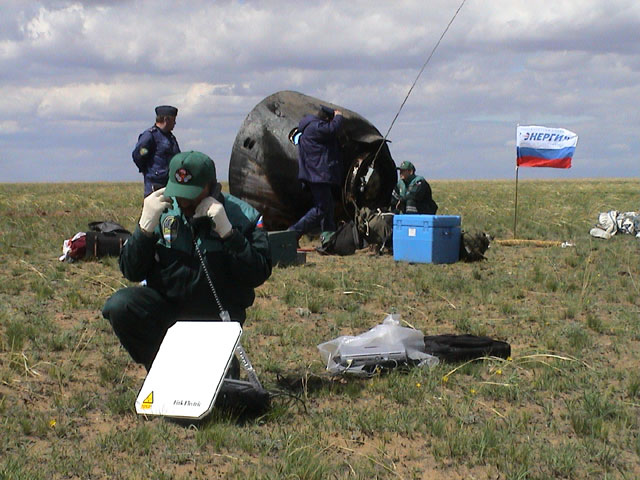
Expedition 6, soon after the recovery crew arrived.
Source: Spaceref.com.

The ISS can't stay untended for long, so NASA and the Russian Space Agency had to cobble together a last-minute Expedition 7 to replace Pettit, Bowersox, and Budarin. Even with the ISS's amazing recycling capabilities (every drop of water aboard the station -- the vapor the crew exhales in each breath, their urine, water evaporating from drying laundry -- is recycled) the station still requires constant resupply of hydrogen, oxygen, food, and space parts.

Long-exposure photo of stars taken on board the ISS.
Source: Time.com.

As an aside, I should mention that even though the Station is dependent on Earth, it does recycle enough hydrogen and oxygen to save $700 million a year in the cost of replenishing supplies. Chris Jones' Too Far From Home provides an example of just how this recycling works in practice: Pettit's favorite snack in orbit was bread and honey, and he'd use a disposable wet wipe to clean up the sticky mess after eating. Before throwing away the used wet wipe, he'd leave it out to dry for a few hours. That way, the ISS recycling system could reclaim the tiny bit of water in the wet wipe!

International Space Station Expedition 6 Crew.
Source: NASA.

Without the space shuttles flying, there weren't as many supplies being ferried up to the station. This meant that Expedition 7 was crewed by only two men instead of the usual three: Astronaut Ed Lu and Cosmonaut Yuri Malenchenko. Both men were veterans of multiple past missions, and had flown together (and gotten along quite well) during a 2000 Atlantis mission. After they were picked, Ed had just a few short weeks to train for his unexpected Soyuz launch.

Expedition 7. Lu added an STS-107 mission patch to his suit before the launch, in honor of Columbia's last crew.
Source: NASA.

Launching in April with a bunch of extra supplies, the two men spent just a just a few days on the Station with Pettit, Bowersox, and Budarin before Expedition 6 returned to Earth. Then, for the next nearly five months, it was just Lu and Malenchenko in Earth orbit... except for a few hours on October 15, when they were joined in outer space by Chinese astronaut Yang Liwei, whose capsule orbited 40 miles below the Station.

Astronaut Yang, after completing China's first manned space flight!
Source:  nowscape.com.

Lu and Malenchenko shared something in common that I don't think any other spaceflight crews have: they were both engaged to be married when they went into space! Lu had proposed to his fiancee, Christine Romero, in Star City a week before he launched. Malenchenko had also recently gotten engaged when he was picked to fly. Lu and Romero were married a year after the launch, in May 2004. Malenchenko, however, was married in August 2003, while aboard the International Space Station(!!!)


Ed Lu and Christine Romero, back at Johnson Space Center after Expedition 7's return.
Source: NASA.

Malenchenko and his fiance Ekaterina Dmitrieva took advantage of a quirk of Texas law that allows a wedding to proceed by proxy with one party absent. Kat Dmitrieva, a Russia-born Texan, walked down the aisle of an auditorium at NASA's Johnson Space Center in front of several hundred guests. Meanwhile, floating about 240 miles above New Zealand, Malenchenko hovered in front of a video camera and TV screen, with Ed Lu, his best man and only witness, floating beside him. Lu played "here comes the bride" on the station's electronic keyboard. Following the ceremony, everyone (except Malenchenko and Lu) enjoyed a wedding reception at a fancy restaurant nearby.

A lifesize cardboard cutout of Malenchenko, bowtie added, attended the wedding reception.
Source: MSNBC.

The extraterrestrial couple's road to the alter was not without a few bumps. Apparently the Russian Space Agency was a little iffy about allowing the wedding to proceed... Malenchenko is a military officer, and there are restrictions on marriages between officers and foreign citizens. But eventually they gave the wedding their go-ahead. The couple will celebrate their ten year anniversary this July; they have one son. Lu and Romero are coming up on their ninth anniversary, and also have a child.

A wedding chapel with a view.
Source: zmescience.com.

Sources: MSNBC; Florida Today; Wikipedia; and a great audio book I've been listening to lately: Chris Jones's Too Far From Home, the story of Pettit, Bowersox, and Budarin's time on the international space station following the Columbia disaster.

Monday, January 21, 2013

The Space Shuttles' Faithful Friends

For over thirty years, a small fleet of airplanes made possible each space shuttle flight. First, there's the Northrop T-38 Talon. The T-38 is the world's first supersonic jet trainer, and the longest serving, as T-38s are still in use today. During the heyday of the space shuttle program, NASA operated a fleet of over 30 of these little airplanes, which were used to train astronauts and employed as chase planes during the first space shuttle landings and space shuttle transport flights.

Five T-38s fly in formation over the Space Shuttle Enterprise, in 1977.
Source: NASA.

Astronauts have relied on T-38 jets for transportation between Cape Canaveral, Houston, and a myriad of other training destinations. Access to these jets also kept military pilot astronauts' flying skills sharp. But in the early days of manned space flight, T-38 crashes killed a stunningly high fraction of NASA's astronauts. Of the first 30 astronauts hired by NASA in the late 1950s and 1960s, four died in T-38 crashes: Theodore Freeman, Elliot See, Charlie Bassett, and C.C. Williams. The high fraction of T-38 fatalities likely says more about the amount of time the astronauts were spending flying T-38s (a whole lot of time) than any other contributing factor.

Astronaut Theodore Freeman, biking to work at Mission Control in Houston.
Source: lightthiscandle.tumblr.com.

Despite that grim statistic, many astronauts think the T-38 is a nice plane to fly. It is relatively predictable, with few unusual difficulties. But... only experienced pilots can fly the T-38. According to what I've read, NASA currently only allows astronauts who are military pilots (on active duty, not retired) to fly its T-38s. It's not a forgiving aircraft, especially at slower speeds. It is relatively hard to handle on landing because of its high stall speed.

One of NASA's T-38s in flight.
Source: Wikipedia.

In addition to being used for crew training and transport, T-38s were used as chase planes, to observe early space shuttle flights (the first seven shuttle flights or so). T-38 crews would fly behind the shuttle as it approached the runway, confirming that the spacecraft's landing gear has been extended and gathering data on the craft's performance.

A T-38 chases Columbia on the shuttle's inaugural landing in 1981.
Source: astrosaur.us.

As I mentioned, the T-38 is part of a whole fleet of aircraft that supported shuttle missions. There were two modified Boeing 747s that served as Shuttle Carrier Aircraft (SCA); these are perhaps the most well known NASA planes. The T-38s have worked with them too, for example accompanying the shuttles and SCAs as chase planes on the final shuttle flights last year.

Atlantis, being mated to a shuttle carrier aircraft.
Source: Wikipedia.

There were four modified Gulfstream II aircraft used to train shuttle pilots with simulated shuttle landings. They were also occasionally used in place of T-38s to transport shuttle crews. I talked in more detail about how that training worked in another blog post.

The shuttle controls are on the left; regular Gulfstream II controls are on the right.
Source: NASA.

NASA also operated two Martin WB-57Fs, called NASA 926 and 928. NASA 926 and 928 are unique in that they the only two Martin WB-57Fs still in service anywhere in the world today. These aircraft served as chase planes during each shuttle launch. 

STS-114, Space Shuttle Discovery, launching. 
The view from one of NASA's WB-57s.
Source: Youtube.

They were modified to carry a special high-definition camera,  and could cruise at a high altitude, tracking the launch. Historically, 926 and 928 been used not just to observe shuttle launches, but for other scientific purposes, as they are equipped with a range of sensors and can carry very large payloads.

NASA's 928, back in the space shuttle days.
Source: Wikipedia.

As is true for the other aircraft I've discussed, NASA has less use for the 926 and 928 since the shuttles stopped flying. But while NASA may not be using 926 and 928 these days, someone else is. These two planes started showing up at airbases in Afghanistan and elsewhere a few years ago, with new low-profile paint jobs. Presumably, they are in use by another government agency, on a not-space-related, secret mission.

A 2012 photo of NASA 928, repainted.
Source: Wikipedia.

It seems a little sad that these two airplanes, the last of their kind, are no longer tasked with observing launching spaceships. NASA 925 was retired in the early 1980s, sits at the Pima County Air Museum in Tuscon, Arizona. One of the four Gulfstream II trainers has also been retired, since 2011 it has sat at the Texas Air & Space Museum in Amarillo. NASA is set to retire half of its T-38 fleet by 2015.

NASA's two shuttle carrier aircraft.
Source: Wikipedia.

What's next for NASA 928 and 926, the three remaining Gulfstream IIs, and what's left of the T-38 fleet? Are they all destined for museums, scrapyards, or re-purposing  in a few years? Or, as the United States begins launching manned space missions again, will there be a renewed role for these veteran airplanes?

Sources: NASA; Arlington Composite Squadron; Collect Space; Astrosaur; Wikipedia; theaviationist.com.

Sunday, January 13, 2013

Carnival of Space #284!

Welcome to the Carnival of Space! This is my second time hosting the Carnival; you can find my first Carnival hereThe Carnival is a weekly round-up of space stories from around the internet. If you've got a space-related blog, you too can join the Carnival of Space. Email carnivalofspace at gmail dot com to host, share a story you wrote, and to get to know other space bloggers. 

Source: pintrest.com.
This week's carnival will take you on a voyage around the world; into outer space; to the distant and not-so-distant past... and will explain how you can get there!

Travel to the Sahara Desert: Links through Space shares the story of the Astronomy Club Toutatis's recent trip to Morocco, where club members viewed the club's namesake asteroid, Asteroid 4179 Toutatis, in the night sky over the Sahara. More stories on their trip (and photos!) can be found here.

Watch our moon travel in front of the star Spica, and watch an asteroid fly by the Earth: Astroblogger shares photos and details on his observations of the moon's recent occultation of the blue giant Spica. Also on Astroblogger, you can read the good news that imaging of Asteroid Apophis on its recent flyby proves that that asteroid definitely won't hit Earth in 2036. 

Source: ebay.
Travel to Canberra, Australia: Cheap Astronomy is dedicated to exploring outer space for free (or nearly free). They've posted a podcast answering listeners' questions on a variety of topics.

Secretly fly into low Earth orbit: Weird Warp reports on last week's launch of the U.S. Air Force's secretive X-30 7B space plane. It's a very interesting overview of what's known of the craft's missions and specs.

Source: pintrest.com.

Voyage to the Winking Demon: Hablo espaƱol? Vega 0.0's Spanish-language post explains how to observe a stellar eclipse in the Algol star system. (An Algol is a demon, hence the system's creepy nickname, "winking demon.")

Travel almost a thousand light years away: Chandra X-Ray Observatory shares observations of the Vela Pulsar, a relatively young pulsar that's a little less than 1,000 light years away. You can also watch a movie of the Vela pulsar spinning! It is turning at a rate of over 11 rotations a second- which is faster than a helicopter rotor!

Source: juxtapost.com.
Journey into NASA's past: NASA's Dryden Flight Research Center might be renamed in honor of Neil Armstrong. But who was Dryden, anyway? The Once and Future Moon shares the story of Hugh Dryden's life, and his significant contributions to aeronautical engineering.

Time travel into the ancient past: Supernova Condensate takes readers a few billion years into the past, to examine new evidence that ancient Mars may have been a watery, Earth-like world.
Source: tentimesone.com.


How might we voyage beyond our solar system? Next Big Future covers the work of researchers seeking to use the Mach Effect to create propellant-less space travel and possibly even to travel via wormholes. Also at Next Big Future you can also read about the electric sail, a propulsion method that features electrically charged  metal tethers that interact with solar wind.

End your journey back on Earth, landing on a dirt road. My latest post tells the story of the one time a space shuttle landed on the dried lakebed runway at White Sands Space Harbor in New Mexico.

Sunday, January 6, 2013

A Dirt Road Landing at White Sands Space Harbor

I traveled to New Mexico for work a couple months ago. It was my first visit to that state, and it was just a short trip to Albuquerque. I really wanted to visit White Sands Space Harbor while I was there, but it was hours away. So my only space related sight-seeing occurred in the Albuquerque airport, where I perused a few display cases of aviation and space travel memorabilia...

The closest I've been to White Sands Space Harbor.

Someday I'll follow in my grandfather's footsteps and actually visit White Sands! In the meantime, I've done a little reading about White Sands- turns out that it's a neat little footnote in the history of the space shuttle program.

Of the 133 space shuttle missions to safely return from Earth orbit, 132 landed at Cape Canaveral in Florida or in California at Edwards Air Force Base. There's only one mission that didn't land in California or Florida: STS-3, Columbia, landed at White Sands Space Harbor* in New Mexico in 1982.

*: At the time, White Sands wasn't yet called a 'Space Harbor.' Congress renamed the runway facility the month after Columbia's landing, in honor of that event.

Gliding towards a landing at Edwards Air Force Base.
Source: NASA.

Any of the other shuttle missions could have landed at White Sands, though. It was an abort site for each shuttle launch. It was also the back-up option for landing if bad weather or some calamity foreclosed a landing at Kennedy and Edwards.

White Sands Space Harbor contains the ultimate runway: an enormous and flat dried lake bed. It's nearly 7 miles long. The shuttle's landing strip in the lake bed is 300 feet wide, and engineers further leveled the land on both sides of that strip as well, effectively making it 900 feet wide.

Isn't it funny how a spaceship can end its journey by landing on a dirt road?

Columbia landing at White Sands, accompanied by T-38 chase planes.
Source: NASA.

The shuttle's runways at Edwards Air Force Base were also mainly dried lakebeds. Given the similarities, White Sands was a sensible practice site for shuttle pilot training. Shuttle pilots simulated landings on the White Sands runway in a modified Grumman Gulfstream II business jet launched out of El Paso. They'd do 10 practice landings in one go. The Gulfstream would never actually touch down during the practice runs.  It would just drop down till it was cruising 20 feet off the ground, since that's how high off the ground the pilot sits when the shuttle touches down. At 20 feet off the ground, the Gulfstream's autopilot would kick in, and the jet would take back off for another practice run.

Folks camping out in anticipation of the STS-3 landing.
Source: jameshohnsonfamily.com.

White Sands' role as a training facility partially explains why Columbia landed there in 1982. Columbia was scheduled to land at Edwards Air Force Base, like every shuttle flight had to that point. But Edwards' lake beds were flooded, so it wasn't an option. Columbia's crew chose to land at White Sands over Kennedy. They preferred White Sands since all their training had been on that runway. White Sands' runway was also several times larger then Kennedy's, another factor working in its favor. Actually, no space shuttles landed at Kennedy until nearly two years later.

The crew of STS-3: Commander Jack Lousma and Pilot C. Gordon Fullerton.
Source: Wikipedia.

Real-life space travel is (sadly) far more complicated than science fiction space travel. Columbia's crew couldn't just pick their landing spot, touch down, and be done with it like we see on Star Trek or Firefly. Massive ground support is necessary. The switch from Edwards to White Sands was made about two weeks before the landing, and the space shuttle program was still in its infancy. So, White Sands was not fully equipped for a landing. Much of the set-up for a landing at Edwards needed to be moved to White Sands. NASA equipped 40 train cars on two separate trains to move equipment the over 1,000 miles between Edwards and White Sands.

Serenity landing in the desert, with much less fuss.

STS-3's White Sands landing was planned for the seventh day of its mission. Commander Jack Lousma recalls that they'd packed everything, suited up, and were strapped in and ready to de-orbit when ground control scrubbed the landing. There was a bad windstorm at White Sands and visibility was too poor for a landing. So, Commander Lousma and Pilot C. Gordon Fullerton were treated to an extra day in space (as Lousma put it, "an extra day in our world's favorite vacation spot") as they waited for conditions to improve. They needed to land soon; they were running out of consumables.

STS-3 lands at White Sands.
Source: NASA.

Meanwhile, on Earth, crash/rescue teams at White Sands ran last minute practice drills. Thousands of people from nearby towns, excited to see a shuttle landing, gathered at White Sands. The crowd was on hand to enthusiastically greet the second supply train when it arrived from Edwards. Winds in the area finally died down enough that a landing was possible.

So, Columbia landed at White Sands on March 30, 1982. By Commander Lousma's account, the landing went very well and there weren't any complications.

Markings painted onto the lake bed, creating a runway at White Sands.
Source: Abandoned & Little-Known Airfields: New Mexico.

White Sands was almost used again in 2006, when Discovery's planned landing at Kennedy was nearly rained out. Landing at Edwards was not an option because of high cross-winds. The first window for a Kennedy landing was abandoned, but the second window presented better conditions in Florida, so there was no need to land at White Sands after all.

The only other time a shuttle ever traveled to White Sands was on the back of a Boeing 747 in September 2012. Endeavor flew over the Space Harbor on its way to its final home at the California Science Center.

Endeavor over Las Cruces, New Mexico in September 2012.
Source: abqjournal.com.
Sources: NASA; MSNBC; AP News Archive; Holloman Air Force Base; Johnson Space Center Oral History Project; Wikipedia; El Paso Times.

Sunday, December 16, 2012

A Teacher in Space

What a sad week. More than usual I've been thinking about, and grateful for, teachers. Looking for a distraction from the news out of Connecticut, I read about the role teachers have played in space exploration. So, if you're looking for a distraction too, that's what this post is about. 

Teachers in Space: Barbara Morgan and Christa McAuliffe.
Source: Wikipedia

Neil Armstrong returned home from the moon to teach at the University of Cincinnati, and there are many other examples of college professor astronauts in the years since he walked on the moon. But, today's post explores the history of primary school teachers in space ... aside from their obvious, fundamental role: laying the foundation of math and science education necessary to become a rocket scientist or astronomer or an astronaut!

NASA announced its first Teacher in Space project in 1984, to build enthusiasm for space exploration, math, and science among U.S. students. Over 11,400(!) teachers applied to be picked as citizen astronauts in NASA's Teacher in Space program, and two women were chosen. Christa McAuliffe, who launched and died aboard Challenger's last mission, and her backup, Barbara Morgan.


The NASA Teacher in Space Project Logo
Source: Wikipedia.

In pretty much every single photo of Christa McAuliffe I came across while researching this post, she's got a huge grin on her face. It's obvious how excited she was to be picked for the Challenger mission. Christa was a high school history teacher when she was selected in 1985. It's interesting that she wasn't a math or science teacher, isn't it? It sounds like she was picked based on her character more than her background. According to NASA administrators and her former students, Christa's enthusiasm for learning rubbed off on everyone she encountered.


Barbara and Christa, aboard a KC-135
Source: NASA.

As a history teacher, Christa had a unique view of space exploration: "I think just opening up the door, having this ordinary person fly, says a lot for the future ... you can always equate astronauts with explorers who were subsidized. Now you are getting someone going just to observe. And then you'll have the settlers, the space station is not too far down the road."


Christa with her son and daughter, July 1985.
Source: MSNBC.

As the first private citizen in space, Christa planned to document her trip aboard Challenger with daily journal entries, so that "like a woman on the Conestoga wagon pioneering west, I too would be able to bring back my thoughts and my journal to make that a part of history." And, if she had lived to make it into orbit, the plan was for Christa to teach classes of school kids live via TV from outer space. 


Christa McAuliffe in an astronaut jet trainer.
Source: NASA.

Christa believed that her space flight would be safe. She told a reporter in 1985 that the "space shuttle isn't the type of thing, I think, that anybody really looks at with fear that there's going to be an accident ... I feel, probably, safer doing something like that than driving around the New York streets." Christa's life insurance company had some doubts, though. It cancelled her policy after she was selected to fly. She was only insured when she died because a private aerospace company donated a $1 million dollar policy before her flight.

Others at NASA shared Christa's belief that space travel had become routine and safe. History of course tells a different story: that sense of complacency, along with bureaucratic bungling and a bad decision to launch, killed all seven Challenger astronauts on January 28, 1986.

Christa McAuliffe training for microgravity in a KC-135.
Source: readplatform.com.


What became of the other NASA Teacher in Space participant, Barbara Morgan? Barbara left NASA a few months after Christa died, returning home to teach second and third grade in Idaho. But, she was not done with outer space! Over a decade after the Challenger tragedy, Barbara was selected to serve as a NASA Mission Specialist. She began training for a space mission, just like any other astronaut candidate. For several years, she served as CAPCOM, communicating with space crews from Mission Control in Houston. 

Barbara flew in space once, on a mission to the International Space Station in 2007. Her primary tasks were operating the shuttle's robotic arm, and overseeing the transfer of supplies between the shuttle and the ISS. In orbit, she also took questions from students in Idaho and at the Challenger Center for Space Science Education.


Barbara Morgan, a teacher in space.
Source: Collect Space.

The Teacher in Space program was cancelled a few years after Christa died, but other primary school teachers have flown as educators in space in the years since, as part of subsequent NASA Educator in Space initiatives. These include Dorothy Metcalf-Lindenburger, who was a Washington science teacher when she was selected as an astronaut candidate in 2004. In 2010, she became the first Space Camp alumna to fly in space. :-) Other teacher astronauts include Richard Arnold, a high school science teacher who flew to the International Space Station in 2009, and Joe Acaba, the first Puerto Rican astronaut and the first middle school teacher in space. He has flown several missions to the ISS, including one this year.


One of Joe Acaba's mission photographs (Expedition 31).
Source: Wikipedia.

So in a way, Christa was right after all. She was a pioneer. Others followed after her, and they traveled to a space station. It just didn't work out quite the way I wish it had. 

Christa McAuliffe and Barbara Morgan watch the Space Shuttle Challenger launch in October 1985.
Source: NASA.

So, that's the story of the first American teachers in space. Writing it was a nice break from the sad reality I've been thinking about all weekend. And speaking of Sandy Hook Elementary, if you're looking for a way to help out, here are a few ideas:
Sources: NASA; New York Times; Los Angeles Times; Washington Post; Wikipedia; Educationworld.com; Christa McAuliffe: Reach for the Stars.

Sunday, December 9, 2012

A Moonwalker Invents a Mars Cycler

Before he traveled to the moon, Dr. Buzz Aldrin completed a PhD thesis exploring how to dock spaceships in the event of instrument failure. Since returning from the moon, Dr. Aldrin has been working to get humans to Mars...

Our future?
Source: NASA.

There are manymany, many obstacles to establishing a human colony on Mars. One huge challenge is the cost of ferrying people and the supplies they'll need between the two planets. Another challenge is the length of the trip to Mars. It took four days for Dr. Aldrin to travel from the Earth to the moon; it took the Curiosity Rover nine months to travel from the Earth to Mars.

Mars Science Laboratory, on its way to the red planet.
Source: Wikipedia.

Dr. Aldrin's "Mars cycler" plan comes in handy in addressing both of these challenges. Dr. Aldrin formulated this plan in the mid-1980s. He called for the establishment of a permanent human base on Mars, supplied by a fleet of of uniquely tasked spaceships. Some of these spacecraft would be used to ferry people and supplies between the surface of Earth and Earth orbit; some would transport people and supplies between the surface of Mars and Mars orbit. Meanwhile, traveling between Mars and Earth there would be a continuous cycle of interplanetary spacecraft: "cyclers."

These cyclers would essentially be space stations orbiting a path that would take them between Earth and Mars every few months. They'd be similar to the international space station, but with heavy-duty rockets attached, more radiation shielding, and maybe a big centrifuge creating artificial gravity. You could have two of these cyclers, with one always going towards Earth and one away. Or you could launch even more cyclers, allowing for more frequent trips between the two planets.

A Mars cycler approaches Mars.
Source: Scientific American, March 2000.

One upside to the cycler is that it makes a faster trip to Mars than traditional spaceships. In contrast to Curiosity's nine month trip to Mars, the cyclers could make the same trip in just five months. Cyclers are faster because they take advantage of a gravity assist. Meaning, they are aimed for a close encounter with Earth and then Mars, hurtling around each planet before shooting out back towards the direction they came from, picking up a bit of the planet's momentum as they go. Gravity assisted spacecraft (like the Voyager spacecraft) can build up much higher speeds than just firing a rocket.

Voyager 1 gained the momentum needed to escape the Sun's gravity via a gravity assist from Jupiter and Saturn.
Source: Wikipedia

The cyclers have other advantages. You don't have to pay for the fuel to repeatedly accelerate or decelerate the spacecraft when they reach Earth or at Mars, and you aren't constantly building giant spaceships capable of leaving Earth's atmosphere and landing on Mars. In these multi-stage spacecraft, almost every stage gets discarded after accelerating and decelerating between Earth and Mars.

The little bitty command module, that I've circled in red, is the only bit of Apollo 11 that made it home to Earth.
Source: Universe Today.

Are there downsides to the Mars cycler? Yes... maintaining the Mars-Earth orbit requires more than just the occasional course correction boost that the International Space Station gets to maintain its Earth orbit. As Dr. Aldrin acknowledges, "moderately large" maneuvers are required at irregular intervals to keep cyclers from smashing into a planet or zipping out of orbit into empty space. But, that said, the cycler is still essentially an orbiting space station: it is not having to expend massive amount of propellant to escape Earth or Mars gravity every time it flies to those planets.

Another problem is actually reaching the cycler from vehicles launching from Earth or Mars. The launch craft must catch up as the cyclers make their once-every-five-months pass by the Earth or Mars. The cycler could be travelling as fast as 27,000 miles per hour as it encounters Mars. That's close to the fastest speeds that the Apollo spacecraft ever traveled. So, a rocket leaving Mars attempting to rendezvous with the cycler would expend a great deal of energy. Or, alternatively, you could significantly slow down the cycler when it reaches Mars (by aerobraking- dipping into and out of the Martian atmosphere, with the friction of Martian air slowing the craft down). Then, it would be easy for a spaceship leaving Mars to rendezvous with the slowed cycler... though the cycler would need a big rocket boost to speed up and travel back to Earth.

An illustration of Mars Reconnaissance Orbiter aerobraking on arrival to Mars.
Source: Wikipedia.

Will humans ever hitch a trip to Mars on a cycling interplanetary space station? Nearly thirty years after he first proposed it, Dr. Aldrin's cycler idea still seems like a doable approach to establishing a long-term human presence on Mars. So, whether Mars Cyclers come to pass probably depends on our dedication to exploring the solar system.

Sources: Next Big Future; March 2000 Scientific American; buzzaldrin.com; NASA; D.V. Burnes, J.M. Longuski; B. Aldrin, Cycler Orbit Between Earth and Mars, Journal of Spacecraft and Rockets (1993); Buzz Aldrin et al.; Evolutionary Space Transportation Plan for Mars Cycling Concepts.

Saturday, December 1, 2012

Dr. Buzz Aldrin and the Orbital Paradox

"In the hopes that this work may in some way contribute to their exploration of space, this is dedicated to the crew members of this country's present and future manned space programs. If only I could join them in their exciting endeavors!"


--  Edwin "Buzz" Aldrin's  Thesis Dedication, January 1963

Dr. Buzz Aldrin, after his stroll on the moon.
Source: Wikipedia.

Dr. Buzz Aldrin goes down in history as the second man to walk on the moon. He was also the first PhD in space. He submitted his thesis in January of 1963; he was selected as an astronaut in October of that year.* Dr. Aldrin's dramatic and sometimes troubled life story (Dancing with the Stars, three divorces, alcoholism, etc...) sometimes seems to overshadow his scientific accomplishments. But, before walking on the moon, he was the first person on Earth to earn a doctorate in the field of astronautics. MIT actually created its astronautics program specifically for him!

*: Astronaut Jim McDivitt was awarded an honorary doctorate before he flew on Apollo 9, but Aldrin was the first astronaut hired with a ScD (equivalent to a PhD) degree.

The view from Apollo 11, leaving Earth orbit for the moon.
Source: Wikipedia.

Astronautics is the study of space navigation. Dr. Aldrin's research focused on the process of docking two orbiting spacecraft. When Dr. Aldrin was completing his coursework, humans hadn't yet docked two spacecraft in orbit. The first docking occurred on Gemini 8, in 1966. Soon thereafter, Dr. Aldrin flew aboard  Gemini 12 and was able to follow up on his doctoral work with hands-on experience.

Dr. Aldrin in his pre-PhD days.
Source: Time.

Dr. Aldrin's thesis was titled Line-of-Sight Guidance Techniques for Manned Orbital Rendezvous. It's available for download here. His doctoral work was the development a procedure for visually docking (as in, using your eyes to guide the spacecraft). That way, astronauts would be able to supplement computer models, navigational chart data, or radar data with their own visual observations. Being able to rely on a visual docking technique in addition to following computer and instrument guidance means that docking is possible even if those sources of data partially failed.

So, for example, when the rendezvous radar failed during Dr. Aldrin's Gemini 12 mission, he and  Jim Lovell docked their spacecraft to the target vehicle using the onboard computer, navigational charts, and their own observations out the spaceship windows. Such was the success of Dr. Aldrin's visual docking techniques that parts of the dissertation became standard operating procedure for NASA.

The view from the Apollo 11 Command Module: the Lunar Module approaches.
Source: NASA.

Docking spacecraft in orbit poses serious challenges not encountered when docking a boat or connecting two aircraft for a refueling maneuver  Like air travel, space travel works in three dimensions. But unlike air travel, there's the added challenge of working with craft that are in orbit. There's also the confusion created by freefalling around Earth without a feeling of "up" or "down." And, there's what Dr. Aldrin terms an "orbital paradox."

Here's the paradox: If you're trying to pilot your orbiting spaceship to reach a spaceship in a higher orbit, the intuitive course is to (1) aim your spacecraft up, towards the higher orbit, and (2) speed up your spacecraft so it will catch up. Dr. Aldrin describes the surprising result of this maneuver. You'll "end up in an even higher orbit, traveling at a slower speed and watching the second craft fly off into the distance."

Gemini 12 and an Agena Rocket, 15 feet apart.
Source: Wikipedia.

Or, as Neal Stephenson describes it in his novel Anathem: "Things in orbit didn't behave like we were used to. Just to name one example: if I were pursing another object in the same orbit, my natural instinct would be to fire a thruster that would kick me forward. But that would move me into a higher orbit, so the thing I was chasing would soon drop below me. Everything we knew down here was going to be wrong up there."I won't tell you why the main character in Anathem was headed into space, just in case you want to read the book.... it's a great adventure story!

Apollo 9's command and service modules, docked.
Source: NASA.

Aside from PhD dissertations and science fiction, the practical result of the orbital paradox is as follows. When the International Space Station docks with a Soyuz, the Soyuz and the ISS begin their final docking maneuvers at the same altitude and velocity as each other, but with the Soyuz out in front of the ISS. Then the Soyuz will fire its rocket and move towards a slightly higher orbit, because this slows the craft down! Next, the Soyuz will slowly drop back to the lower orbit, moving faster and closer to the ISS the lower it gets. Finally, the spacecraft will back into the ISS, docking with the front of the space station.

Here's a diagram the boyfriend and I drew to explain how the Soyuz moves to that initial, higher orbit:

See how the Soyuz fires its rockets so that, if it wasn't in orbit, it would move directly away from the ISS?
But since both craft are in orbit, the effect of thrust in that direction is to move the Soyuz to a higher, slower orbit.
Then, it can drop back down towards the ISS.

Teaching folks how to achieve orbital docking by sight is not Dr. Aldrin's only academic contribution to space exploration. There's also Dr. Aldrin's novel idea for exploring Mars, called the Mars Cycler. More on that, coming soon!

Sources: Scientific American; buzzaldrin.com; Neal Stephenson's Anathem; Wikipedia.